Last updated: 12 May 2026 — by Michelle Hawryluk, Managing Director, Hawryluk Legal Advisors (Phuket, Thailand).
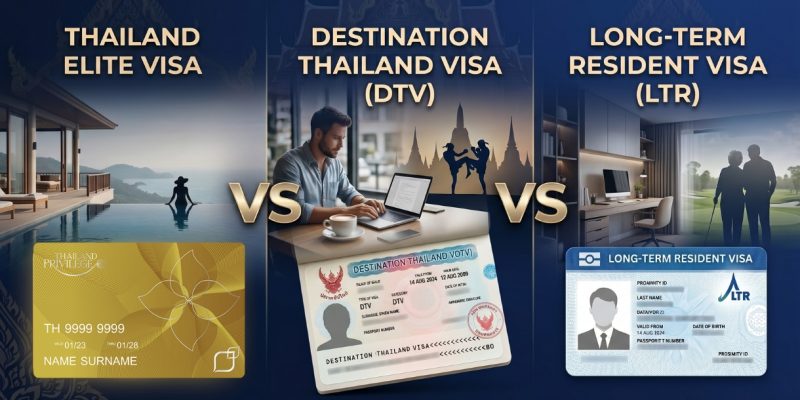
Quick answer: Thailand’s three long-term visa options in 2026 are the Thailand Elite Visa (now officially the Thailand Privilege Card — 5–20 years, lifestyle-driven, no income test), the DTV (5 years multi-entry, for remote workers, 10,000 THB), and the LTR Visa (10 years, BOI-approved, tax incentives for high-earners).
TL;DR: which Thailand visa fits which person?
In 2026, the right long-term Thailand visa depends on three things: how long you want to stay, whether you need to work, and how much you can spend. The Thailand Elite Visa (officially renamed the Thailand Privilege Card in October 2023) is the only option with no income or work requirements and grants up to 20 years. The DTV is the cheapest path for remote workers earning from foreign clients. The LTR Visa offers the strongest tax treatment for high-net-worth applicants and skilled professionals.
| Visa | Duration | Cost | Income test | Work for Thai employer | Best for |
|---|---|---|---|---|---|
| Thailand Elite Visa (Privilege Card) | 5 / 10 / 15 / 20 years | 650,000 – 5,000,000 THB | None | No | Retirees, families, lifestyle relocators, frequent visitors |
| DTV (Destination Thailand Visa) | 5 years multi-entry, 180 days per stay | 10,000 THB | 500,000 THB bank balance, 3 months | No | Digital nomads, remote workers, soft-power activity participants |
| LTR Visa | 10 years (5+5) | 50,000 THB processing | USD 80,000+ annual income or USD 1M assets | Yes, with permit | High-earners, retirees with strong passive income, tech professionals |
What is the Thailand Elite Visa (now Thailand Privilege Card)?
The Thailand Elite Visa, officially renamed the Thailand Privilege Card in October 2023 is a long-term, multiple-entry residence visa issued by Thailand Privilege Card Co., Ltd., a wholly owned subsidiary of the Ministry of Tourism and Sports. The program has run continuously since 2003. Members receive 5, 10, 15, or 20 years of residence depending on their tier, along with VIP airport service, immigration fast-track, concierge support, and access to a points-based privileges system.
There is no income requirement, no work permit attached, and no obligation to invest in Thailand. The program is paid for upfront with a one-time membership fee.
Current 2026 tier structure:
| Tier | Duration | Membership fee (THB) | Points per year |
|---|---|---|---|
| Bronze | 5 years | 650,000 | n/a (promotional tier, extended to 30 Sep 2026) |
| Gold | 5 years | 900,000 | 20 |
| Platinum | 10 years | 1,500,000 | 35 |
| Diamond | 15 years | 2,500,000 | 55 |
| Reserve | 20 years | 5,000,000 (invitation only) | 120 |
Family members can be added to Platinum, Diamond, and Reserve tiers.
What is the DTV (Destination Thailand Visa)?
The DTV is a 5-year, multiple-entry visa introduced in mid-2024 for remote workers and participants in approved “soft power” activities. It costs 10,000 THB and allows stays of 180 days per entry, extendable in-country once for another 180 days before requiring a border run. The applicant must show a bank balance of 500,000 THB held for at least three months.
The DTV permits remote work for non-Thai employers or non-Thai clients without a work permit. It does not permit employment by a Thai company or local freelance work for Thai clients. Soft-power categories include Muay Thai or Thai cooking courses, medical treatment, sports training, short-term study, and participation in artistic or musical events.
What is the LTR (Long-Term Resident) Visa?
The LTR Visa is a 10-year residence visa administered by the Thailand Board of Investment (BOI), structured as a 5-year initial term renewable for another 5 years. Processing costs 50,000 THB per person. Approval depends on qualifying under one of four categories:
1. Wealthy Global Citizens — at least USD 1 million in assets, of which USD 500,000 must be in Thai assets.
2. Wealthy Pensioners — age 50+, USD 80,000 annual passive income, or USD 40,000 income plus USD 250,000 in Thai assets.
3. Work-from-Thailand Professionals — remote workers for established foreign companies with USD 80,000+ annual income over the past two years.
4. Highly Skilled Professionals — experts in targeted industries earning at least USD 80,000 per year (some exceptions for academia).
LTR holders may obtain a Thai work permit, qualify for a flat 17% personal income tax rate (Highly Skilled Professionals), and receive a blanket exemption on foreign-sourced income (Wealthy Global Citizens and Wealthy Pensioners). The 90-day immigration report is replaced by an annual one, and re-entry permits are waived.
Side-by-side: eligibility, work rights, family, and tax
Eligibility
The Thailand Elite Visa has the simplest eligibility test: any nationality, clean criminal record, valid passport, no prior overstay. There is no income, asset, or investment threshold. This is the only one of the three visas with no financial test.
The DTV requires proof of 500,000 THB in a bank account held for three months, plus evidence that the applicant is either a remote worker for a non-Thai employer or a participant in a soft-power activity. The category-specific documents drive most rejections.
The LTR requires the most documentation. Wealth-based categories need audited asset proof. Income-based categories need two years of tax returns or equivalent. BOI processing typically takes 60 days.
Work rights
The Thailand Elite Visa does not permit working in Thailand. It is a residence visa, not a work visa. Members who want to work in Thailand typically convert to a Non-Immigrant B visa with a work permit, which is a separate process.
The DTV permits remote work for foreign employers and clients. It does not permit employment by Thai companies or freelance work for Thai clients.
The LTR is the only one of the three that natively supports working in Thailand. Holders in the professional categories can obtain a Thai work permit and benefit from the 17% flat tax rate in qualifying industries.
Family inclusion
The Thailand Elite Visa allows family add-ons at Platinum tier and above at 500,000 THB per dependent. There is no limit on the number of dependents at Reserve tier.
The DTV covers legal spouse and children under 20 under a single application.
The LTR covers spouse and up to four children. Family members receive the same 10-year visa term as the principal applicant.
Tax treatment (2026)
Thailand’s foreign-sourced income remittance rule, enforced from 2024 and reinforced in 2025–2026 guidance, makes anyone who is tax-resident in Thailand (180+ days per calendar year) potentially liable for Thai income tax on foreign income remitted into the country in the same year it is earned.
Insurance
You cannot or will not satisfy an insurer. The LTR Visa requires health cover; the Thailand Privilege Card does not. If you are over 60 or have a pre-existing condition, this factor alone can decide the choice.
* Thailand Elite Visa holders have no special tax exemption. If they become tax-resident, normal Thai personal income tax rules apply.
* DTV holders who stay over 180 days in a calendar year become tax-resident and face the same rule.
* LTR Wealthy Global Citizens and Wealthy Pensioners are exempt from tax on foreign-sourced income. This is the LTR’s strongest financial advantage and the main reason high earners pick it over the elite visa.
* LTR Highly Skilled Professionals pay a flat 17% on Thai-sourced income, well below the 35% top marginal rate.
Cost over time: what each visa actually costs per year
Membership fees are not directly comparable because the visas have different durations and benefits. Here is the effective cost per year of residence rights:
| Visa | Headline cost | Years | Annual cost equivalent |
|---|---|---|---|
| DTV | 10,000 THB | 5 | 2,000 THB/yr |
| Elite Visa Bronze | 650,000 THB | 5 | 130,000 THB/yr |
| Elite Visa Gold | 900,000 THB | 5 | 180,000 THB/yr |
| Elite Visa Platinum | 1,500,000 THB | 10 | 150,000 THB/yr |
| Elite Visa Diamond | 2,500,000 THB | 15 | 167,000 THB/yr |
| Elite Visa Reserve | 5,000,000 THB | 20 | 250,000 THB/yr |
| LTR | 50,000 THB | 10 | 5,000 THB/yr |
These numbers ignore the privileges side of the Elite Visa such as airport transfers, lounges, concierge, points which a heavy user can convert into 100,000+ THB of value per year. They also ignore the LTR tax savings, which for a high earner remitting USD 200,000 of foreign income can exceed USD 30,000 per year.
When the Thailand Elite Visa is the right choice
The Thailand Elite Visa is the right choice when one or more of the following apply:
* You want certainty over 10, 15, or 20 years without periodic renewals or border runs.
* You cannot meet, or do not want to document, the income and asset tests for the LTR.
* You do not need to work in Thailand.
* You value the VIP airport service, lounges, immigration fast-track, and concierge perks.
* You travel in and out of Thailand frequently and want a smooth experience.
* You are a retiree under 50 (the standard Retirement Visa requires age 50+).
* You are a family with school-age children and want a multi-year base in Thailand.
* You want to open a Thai bank account.
It is NOT the right choice if you need to work for a Thai employer, if your only goal is the cheapest possible visa (DTV wins), or if you qualify for the LTR and your priority is tax efficiency on foreign income (LTR wins).
When the DTV is the right choice
The DTV is the right choice when:
* You are a remote worker, freelancer, or business owner with income entirely from outside Thailand.
* You are happy to spend roughly half the year in Thailand and the rest elsewhere.
* You do not want to commit upfront to a six-figure THB membership.
* You qualify under a soft-power category (Muay Thai, Thai cooking, medical treatment, sports training, short-term study, cultural festivals).
It is NOT the right choice if you need uninterrupted residence longer than 180 days at a time, if you might need to work for a Thai company, if you need a Thai bank account, or if you want the predictability of an annual or longer residence with no border runs.
When the LTR Visa is the right choice
The LTR Visa is the right choice when:
* You can document USD 80,000+ in annual income or USD 1 million in assets.
* You want a Thai work permit and the flat 17% tax rate for qualifying professionals.
* Your foreign-sourced income is significant and you want the blanket tax exemption (Wealthy categories).
* You can navigate BOI documentation requirements (audited financials, tax returns).
It is NOT the right choice if you cannot or prefer not to document financial qualifications, if BOI processing time is a concern, or if you want the points-based lifestyle perks the Privilege Card offers.
Can I switch between these visas?
Yes. Many of our clients begin on the DTV to test Thailand for one or two years, then transition to the Thailand Privilege Card once they decide to commit long-term. Others move from a Non-Immigrant B work visa to the LTR once their income passes the USD 80,000 threshold. A change of visa typically requires leaving Thailand and re-entering on the new visa, although some categories allow in-country conversion.
Hawryluk Legal Advisors handles transitions between all three programs, including the document preparation needed for BOI submission and the Thai tax planning that goes with a residency change.
Talk to a Phuket-licensed law firm before you choose
Hawryluk Legal Advisors is a licensed Phuket law firm and an officially appointed GSSA agent of Thailand Privilege Card Co., Ltd. We have represented hundreds of long-term visa applicants and act as legal counsel for the duration of each member’s residence. We can run a full eligibility check across all three programs in a complimentary 15-minute consultation, and successful Privilege Card applicants receive a THB 50,000 legal services credit usable for property, tax, banking, and estate matters.
Speak with our legal team — no obligation →
About the author
Michelle Hawryluk is the Managing Director of Hawryluk Legal Advisors in Phuket, Thailand. The firm is officially appointed as a GSSA of Thailand Privilege Card Co., Ltd., and was awarded the Rising Star Award – 2nd Best Sales of the Year by Thailand Privilege Card Co., Ltd. in 2024. The firm serves clients in English, Thai, Russian, Ukrainian, and Mandarin.
Sources & references
* Part of our Thailand Elite Visa Guide 2026